
Chlorinated Paraffin vs. DOP: A Complete and Technical Comparison
In the polymer industry and plastic product manufacturing, choosing the right “Plasticizer” is the fine line between profitability and loss. Two of the most widely used materials in this field are DOP Oil (Dioctyl Phthalate) and Chlorinated Paraffin (CP). However, the main question for manufacturers is: Is Chlorinated Paraffin better, or DOP?
Can Chlorinated Paraffin completely replace DOP? Which one is more economical? In this comprehensive article, we explore the technical, chemical, and economic aspects of these two materials to help you make the best decision for your production line.
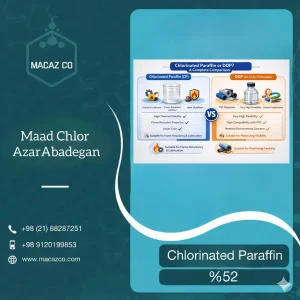
What is DOP Oil? (The King of Plasticizers)
DOP Oil, or Dioctyl Phthalate, is known as the golden standard for plasticizers in the PVC industry. It is classified as a Primary Plasticizer.
Key Features of DOP:
• High Compatibility: DOP molecules fit perfectly between PVC polymer chains.
• Excellent Flexibility: It provides superior softness and elasticity to the final product.
• Thermal Stability: It offers good resistance to heat during the production process.
• Low Migration: It has a low tendency to migrate out of the polymer matrix (under standard conditions).
What is Chlorinated Paraffin? (The Economic Competitor)
Chlorinated Paraffin, or CP, is obtained from the chlorination of paraffin hydrocarbons. It is commonly known as a Secondary Plasticizer or an “Extender.”
Key Features of Chlorinated Paraffin:
• Reduced Flammability: Due to the presence of chlorine, it imparts flame retardancy (self-extinguishing properties) to the product.
• Chemical Resistance: It increases the product’s resistance to water and chemicals.
• Lower Price: Its most significant advantage is its lower cost compared to DOP.
• Diverse Viscosity: It is available in various chlorine percentages (usually 45% to 52%) with different concentrations.
Quick Comparison Table: Chlorinated Paraffin vs. DOP
To better understand the differences, take a look at the table below:
Feature DOP Oil (Dioctyl Phthalate) Chlorinated Paraffin (CP)
Plasticizer Type Primary (Main) Secondary (Auxiliary/Extender)
Price More Expensive Cheaper (Economical)
Flexibility Excellent Moderate (Weak on its own)
Fire Resistance Average (Flammable) Excellent (Flame Retardant)
Thermal Stability Good Weaker (May decompose at high temperatures)
Color Change Low Potential for yellowing at high temperatures
Main Application Hoses, Cables, Synthetic Leather, Shoes Cheap Filler, Fire-resistant Cables, Wire Sheathing
The Main Battle: Which One Should We Choose?
The answer to “Is Chlorinated Paraffin better or DOP?” depends on the type of final product and your priorities. Let’s analyze this from three perspectives:
1.Economic Comparison (Cost Reduction)
If your main goal is to reduce the finished product’s cost, Chlorinated Paraffin is the winner. Smart manufacturers typically use Chlorinated Paraffin to replace a percentage of DOP.
• The Golden Formula: You cannot remove 100% of the DOP, but you can replace a portion (e.g., 30% to 50%) of the DOP share with Chlorinated Paraffin to lower raw material costs.
2.Technical Quality Comparison (Flexibility and Durability)
If you are producing a product that requires high flexibility at low temperatures (such as high-quality hoses or medical equipment), DOP Oil is unrivaled. Excessive use of Chlorinated Paraffin can cause dryness, brittleness, and “exudation” (oil sweating) in the final product.
3.Safety Comparison (Fire Resistance)
If your product is electrical cables, wire sheathing, or flooring that must pass fire safety standards, Chlorinated Paraffin is the better choice. The chlorine atoms in the CP structure prevent the spread of flames.
Can Chlorinated Paraffin Completely Replace DOP?
No! This is a major production mistake.
Chlorinated Paraffin has lower molecular compatibility with PVC compared to DOP. If it is used as a complete substitute:
1. The final product becomes dry and brittle.
2. The oil migrates out of the polymer texture, making the surface oily (Exudation).
3. The risk of material burning increases in the extruder or injection molding machine.Expert Recommendation: The best approach is a combined usage. A ratio of 2 to 1 or 3 to 1 (favoring DOP) is usually recommended. That means adding one kilogram of Chlorinated Paraffin for every three kilograms of DOP.
Specific Applications for Each
Specific Applications of DOP Oil:
• Medical equipment (blood bags, IV tubes)
• Children’s toys (specific grades)
• High-quality synthetic leather
• Stationery (erasers)
Specific Applications of Chlorinated Paraffin:
• Electrical cables and telecommunication wires (due to fire-resistant properties)
• Production of various sealants and mastics
• Traffic and marine paints
• Cutting and metalworking fluids (as an extreme pressure additive)
Conclusion: Who is the Final Winner?
In answer to the question “Is Chlorinated Paraffin better or DOP?”, it must be said that these two materials are not rivals, but complementary to each other.
• If you seek pure quality: DOP is king.
• If you seek profitability and competitive pricing: A smart combination of DOP and Chlorinated Paraffin is your solution.
• If you seek fire resistance: Chlorinated Paraffin is essential.
Final Advice: To achieve a precise formulation, we suggest producing laboratory samples with different percentages (e.g., 10%, 20%, and 30% substitution) and measuring mechanical properties (tensile strength, hardness, and thermal resistance) to reach the optimal point of cost and quality.
Frequently Asked Questions (FAQ)
1. Does using Chlorinated Paraffin cause product discoloration?
Yes, if the Chlorinated Paraffin is of low quality or if there isn’t enough thermal stabilizer in the formula, the product may turn yellow during production.
2. What is the standard substitution ratio of Chlorinated Paraffin for DOP?
This number is not fixed, but typically replacing 30% to 40% of the DOP volume with Chlorinated Paraffin is possible without a noticeable drop in quality.
3. Are there other alternatives to DOP?
Yes, oils like DOTP (Dioctyl Terephthalate) are greener, non-toxic alternatives to DOP, but the discussion around Chlorinated Paraffin mostly revolves around cost reduction.
Buy Quality Guaranteed Industrial Chemicals from Maad Chlor
Maad Chlor Company is one of the reputable suppliers of industrial chemicals in Iran, offering products with guaranteed quality and valid analysis.
If you are looking to procure widely used materials such as:
• Industrial Paraffin for textile, candle making, and lubrication applications,
• Sodium Hypochlorite (Bleach) for disinfection and water treatment,
• Hydrochloric Acid (HCl) for metal cleaning and chemical applications,
The Madchlor team is ready to provide expert consultation and fast shipping across the country.
📞 Direct Contact with Sales Experts: +98 21 88287251
📱 Price Inquiry and Online Order: +98 912 019 9853
Maad Chlor, a reliable choice for supplying high-quality industrial chemicals.