

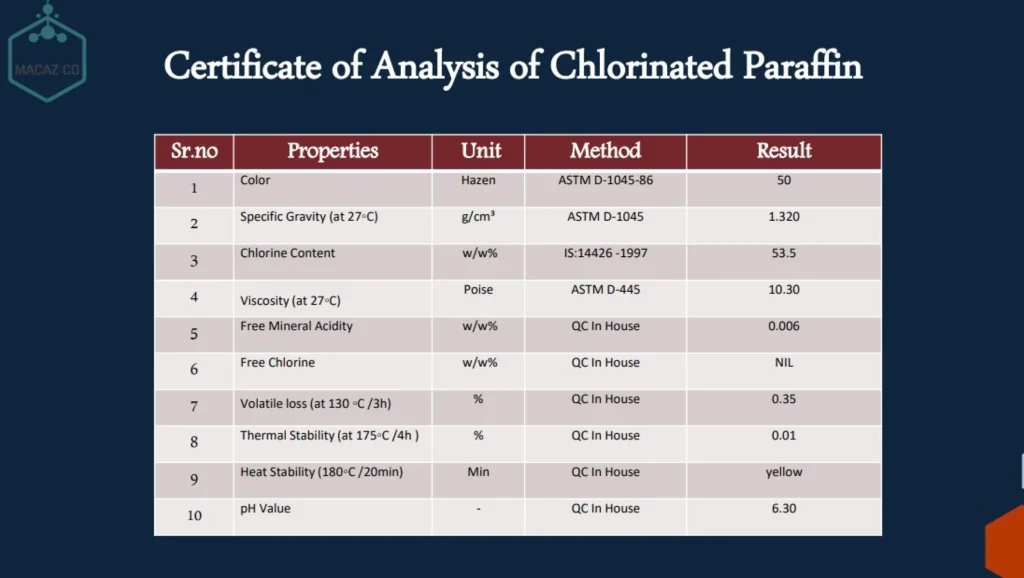
Chlorinated Paraffin 52%±2%
Name: Chlorinated Paraffin
Chemical Formula: CnH(2n+2-m)Clm
Physical Properties: Chlorinated paraffins are physically homogeneous substances. These compounds appear as colorless liquids or liquids ranging from pale yellow, amber yellow, to honey yellow. This material is soluble in organic compounds except ethanol and water.
Applications: Chlorinated paraffins are a group of industrial products obtained by chlorination of paraffin (C10–C30) with a chlorine content of 20–70% by weight.
Stability and Reactivity: The color of most chlorinated paraffins darkens over time when exposed to heat, due to the release of hydrogen chloride gas. Chlorinated paraffin has a flash point above 200°C and a decomposition temperature higher than 120°C. Iron ions and zinc oxide accelerate its decomposition.
Emergency Response and Hazards:
In case of spillage, collect the material with earth or absorbents that do not react with it. Using a shovel, place the collected material in dry, labeled containers and wash the area with water. Cleanup should be performed by trained personnel who must use personal protective equipment.
Handling and Storage:
Transfer and storage must be done in sealed polyethylene containers. The workplace should be equipped with a ventilation system. Observe safety precautions during transportation. Alkali and alkaline earth metals react with chlorine causing decomposition of chlorinated paraffin. Oxidizers and reducers remove chlorine from the compound’s chain.
Packaging: It is supplied in 265‑kg drums.
Applications of Chlorinated Paraffin:
- Manufacturing of medical equipment
- Production of high-voltage cables
- In high-pressure lubricants as an additive
- Production of rubber and plastics (as a pour point depressant)
- Metal cutting processes, as an insulating layer on the metal surface
- In the tanning and leather industry, and also in the production of floor coverings
- Manufacturing of thermal and elastomeric insulations
- Production of various paints
- Polymer industry, especially in PVC production, as a plasticizer and flame retardant
🛡️ Safety and Hygiene – Chlorinated Paraffin
- Use of Protective Equipment
When handling chlorinated paraffin, always wear chemical-resistant gloves, safety goggles, and a respirator mask if necessary, to prevent skin or eye contact and inhalation of vapors. - Proper Ventilation
Work in well-ventilated areas, especially during heating, as vapors may cause irritation to the respiratory system. - Safe Storage
Store in sealed, corrosion-resistant containers, in a cool, dry place, away from direct sunlight and sources of heat. - In Case of Skin or Eye Contact
Immediately rinse the affected area with plenty of water. Seek medical attention if irritation persists. - Inhalation and Ingestion Hazards
Prolonged inhalation may cause respiratory discomfort. Ingestion is harmful and requires immediate medical attention. - Environmental Precautions
Avoid release into soil, waterways, or sewage systems. Chlorinated paraffin can be toxic to aquatic life and is non-biodegradable.