
The Key Role of Chlorinated Paraffin in the Paint and Resin Industry: Advantages, Applications, and Cost Reduction
In today’s highly competitive market, manufacturers in the paint and resin industry are constantly seeking solutions that maintain product quality while reducing production costs. Chlorinated Paraffin (CP) is one of the most important and widely used raw materials that, as a multifunctional additive, offers a smart answer to these needs.
But what exactly is chlorinated paraffin, and how does it affect paint and resin formulations? In this technical article, we examine all the practical aspects of this chemical material.
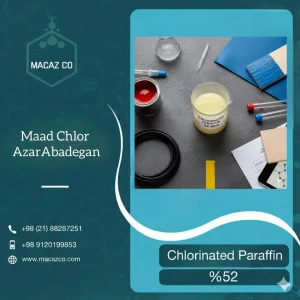
What Is Chlorinated Paraffin?
Chlorinated paraffin (CP) is a family of industrial chemicals produced by the chlorination of paraffinic hydrocarbons. It typically appears as a viscous, colorless to pale yellow liquid. In industry, chlorinated paraffins are classified based on their chlorine content, usually ranging from 40% to 70%.
In the paint and resin industry, the 52% chlorine grade (CP-52) is the most widely used due to its optimal balance between viscosity and stability.
Four Main Roles of Chlorinated Paraffin in the Paint and Resin Industry
The use of chlorinated paraffin is not limited to a single function. This material plays four critical roles in formulations:
- Secondary Plasticizer (Cost-Effective Plasticizer)
The most important application of chlorinated paraffin is as a secondary plasticizer. Primary plasticizers such as phthalates (DOP or DINP) are relatively expensive.
- Economic advantage: Manufacturers can replace part of the costly primary plasticizer with chlorinated paraffin without reducing the physical properties of the final product.
- Flexibility: It increases the flexibility of the paint film and prevents brittleness.
- Flame-Retardant Properties
One of the unique characteristics of chlorinated paraffin is its flame-retardant behavior. When exposed to high temperatures, it releases hydrogen chloride gas, which suppresses combustion.
- Application: This property is essential in fire-resistant paints, industrial coatings, and electrical cables.
- Chemical and Moisture Resistance
Adding chlorinated paraffin to resins and paints enhances the resistance of the final product against environmental factors:
- Water resistance: Excellent resistance to water and moisture penetration.
- Chemical resistance: Stability against acids, alkalis, and oils.
These properties make it ideal for marine paints and swimming pool coatings.
- Improved Gloss and Adhesion
Due to its chemical structure, chlorinated paraffin has good compatibility with various resins (such as alkyd, epoxy, and vinyl resins). This compatibility improves pigment dispersion, resulting in higher gloss and better adhesion of the coating to the substrate.
Specialized Applications of Chlorinated Paraffin in Different Paint Types
To better understand the importance of this material, let’s look at its applications in specific products:
| Type of Paint / Resin | Application | Reason for Use |
| Traffic paints | Road and street marking | Increased abrasion resistance and adhesion to asphalt |
| Epoxy paints | Industrial flooring | Reduced viscosity and improved flexibility |
| Marine paints | Ship hulls and marine structures | Resistance to saltwater and corrosion prevention |
| PVC resins | Artificial leather and cable production | Cost-effective replacement for DOP and flame retardancy |
Technical and Safety Considerations When Using Chlorinated Paraffin
When using chlorinated paraffin in formulations, the following points are essential for chemical engineers and production managers:
- Thermal stability: At very high temperatures (above 200 °C), chlorinated paraffin may decompose. Therefore, in high-temperature curing ovens, it should be used with caution and in combination with suitable stabilizers.
- Environmental compatibility: The use of short-chain chlorinated paraffins (SCCPs) is restricted in some countries. It is recommended to use medium-chain chlorinated paraffins (MCCPs), which are safer and compliant with international standards.
Conclusion: Why Should You Use Chlorinated Paraffin?
The final assessment shows that chlorinated paraffin is not just a simple filler—it is a strategic additive. If you aim to produce a paint that:
- Has a lower final cost,
- Is resistant to fire,
- And performs well in humid and chemically aggressive environments,
then using chlorinated paraffin in your formulation is unavoidable. This material creates an ideal balance between quality and economy.
Frequently Asked Questions (FAQ)
- Does chlorinated paraffin negatively affect the final paint quality?
No. When used at appropriate levels and as a partial replacement for plasticizers, it not only has no negative effect but also improves gloss and flexibility. - What is the best substitute for DOP in paint production?
Chlorinated paraffin is one of the most effective and cost-efficient substitutes for part of DOP in the paint and PVC industries. - What is the typical dosage of chlorinated paraffin in paints?
This depends on the formulation, but it is usually between 5% and 15% of the resin weight.
- Does chlorinated paraffin negatively affect the final paint quality?
Final Note and Direct Purchase 🤝
Chlorinated Paraffin 52% is the backbone of many manufacturing industries. However, purchasing a product with true purity that does not darken under heat is the key to your success.
At Maad Chlor Azarabadegan, by adhering to all international standards—from precise formulation to HDPE packaging—we provide a product that ensures peace of mind for your production line.
📞 Price Inquiry & Technical Consultation
For daily prices (bulk or drum) and free technical consultation, contact us today.
📥 [Contact Maad Chlor
Sales Department]
📦 [Related Product: Industrial Hydrochloric Acid]
📞 Direct sales support: +98 (21) 88287251
💬 Online price inquiry & order registration: +98 9120199853
🌿 Maad Chlor — A Reliable Choice for Supplying High-Quality Industrial Chemicals