
Chlorinated Paraffin Grades: How to Choose the Right One for Your Needs?
Selecting the appropriate grade of Chlorinated Paraffin (CP) is a primary challenge for production managers and purchasing officers in the polymer, paint, and lubricant industries. Although the 52% grade is renowned as the bestseller, is it always the optimal choice for your final product?
In this technical article from Madklor Azarabadegan, we explore the technical, chemical, and functional differences between various grades (including 45%, 52%, and 60%) to help you make an informed and cost-effective decision.
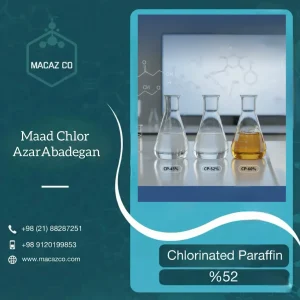
What is Chlorinated Paraffin? (A Technical Overview)
Chlorinated Paraffins (CPs) are homogeneous, predominantly liquid substances obtained by chlorinating linear paraffins with a C10 to C30 carbon chain. The general chemical formula for these compounds is .
Visually, these products have a variable color depending on the chlorine content and production method:
- Water White (Colorless)
- Pale Yellow
- Amber or Honey-Yellow
Solubility: A key property of chlorinated paraffin, crucial in formulations, is its solubility in organic solvents. However, it is important to note that this substance is insoluble in water and ethanol.
Comparing the Main Grades: 45%, 52%, and 60%
The primary difference between these grades lies in the weight percentage of chlorine, which directly impacts their viscosity, stability, and application.
- Chlorinated Paraffin 45% (CP-45)
This grade typically has a lower viscosity compared to the others.
- Key Feature: High fluidity and often a lower price point in certain markets.
- Primary Applications: Mostly used in the leather tanning industry and for certain lubricating oils that require rapid fluid movement.
- Chlorinated Paraffin 52% (CP-52) – The Market Leader
This grade (specified at 52% ± 2%) is the most balanced and widely used type.
- Key Feature: An excellent balance between price, density, and plasticizing properties.
- Primary Applications:
- Polymer and PVC Industries: As a secondary plasticizer and a more affordable alternative to DOP.
- Cable Manufacturing: Especially for high-voltage power cables.
- Rubber Industry: As a pour point depressant.
- Production of PVC Flooring and Hoses.
- Chlorinated Paraffin 60% and Higher
As the chlorine content increases, the viscosity rises sharply, and the product becomes thicker (even solid in 70% grades).
- Key Feature: Very high flame retardancy.
- Primary Applications: Used in marine paints, fire-retardant coatings, and special resins requiring greater hardness and durability.
Quick Grade Selection Guide Table
Application | Suggested Grade | Reason for Choice |
| Flexible PVC Production (hoses, tablecloths) | 52% | Excellent compatibility with PVC resin and cost-effective. |
| Cutting and Metalworking Fluids | 45% – 52% | Creates an insulating layer under Extreme Pressure (EP) conditions. |
| Traffic and Industrial Paints | 60% | Faster drying time and high chemical resistance. |
| Artificial Leather Production | 52% | Provides desired flexibility and softness. |
Stability and Storage Best Practices (Preventing Discoloration)
One of the common questions we receive at Madklor is about the cause of paraffin discoloration. Chlorinated paraffin is sensitive to heat.
- Decomposition Point: Above 120°C (248°F)
- Flash Point: Above 200°C (392°F)
Technical Alert: If the product is exposed to high temperatures, it can release acidic gas (HCl) and darken in color. The presence of iron or zinc oxide ions accelerates this degradation process. Therefore, using High-Density Polyethylene (HDPE) containers—which we utilize for our 220L and 1000L packaging—is the best way to maintain product quality.
Safety Precaution: Strictly avoid storing chlorinated paraffin near alkali metals, oxidizing agents, and reducing agents, as they can cause de-chlorination from the molecular chain.
Special Applications You Might Not Know
Beyond plastics, our product plays a vital role in the following industries:
- Medical Equipment Manufacturing: Due to its plasticizing properties and stability.
- Metalworking Fluids: As an insulating layer in metal cutting operations.
- Thermal and Elastomeric Insulation: To improve flame-retardant properties.
Safety and Purchasing Summary (MSDS)
When handling this material, observing the following points is essential for the health of personnel and the environment:
- Contact: If in contact with skin or eyes, immediately rinse with plenty of water.
- Inhalation: Vapors from heated material can be irritating; proper ventilation of the work area is mandatory.
- Environment: This substance is harmful to aquatic life and should not be released into surface waters or sewage systems.
- Packaging: We provide our products in standard HDPE drums to prevent any reaction with the container material.
Still Unsure Which Grade to Choose?
The quality of chlorinated paraffin directly impacts the transparency, flexibility, and lifespan of your final product. The technical experts at Madklor Azarabadegan are ready to assist you in selecting the most precise grade by providing expert consultation and sending samples.
📞 Call us now for a price quote and to receive a technical data sheet (TDS).
Purchase Industrial Chemicals with Guaranteed Quality from Maad chlor
Maad chlor is a reputable supplier of industrial chemicals in Iran, offering products with guaranteed quality and certified analysis.
If you are looking to source high-demand materials such as:
- Industrial Paraffin Wax for textiles, candle making, and lubrication.
- Sodium Hypochlorite (Liquid Chlorine/Bleach) for disinfection and water treatment.
- Hydrochloric Acid (HCl) for metal cleaning and various chemical applications.
The Maad chlor team is ready to provide expert consultation and ensure fast delivery of products nationwide.
Maad chlor: A reliable choice for high-quality industrial chemical supply.