
Calculating Sodium Hypochlorite Dosage for Pools and Wastewater
Introduction
Did you know that adding sodium hypochlorite “by eye” to pools or wastewater tanks either results in wasted money or endangers people’s health? If the chlorine level is too low, bacteria and algae will grow; if it is too high, it causes eye irritation, skin burns, and respiratory problems.
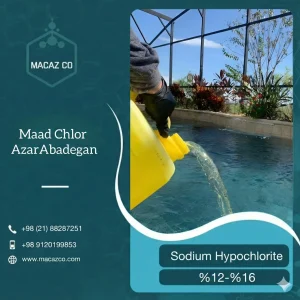
In this technical article by Maad Chlor Azarabadegan, we teach you the exact formula for calculating sodium hypochlorite dosage for swimming pools and wastewater treatment systems so you can achieve the best disinfection quality with minimal cost.
What is Sodium Hypochlorite and Why Does Purity Matter?
Before calculating, you must know what you are pouring into the water. Sodium Hypochlorite (commonly known as liquid chlorine or bleach) is a solution used for disinfection.
- Household Bleach: Usually has a concentration of 5%.
- Industrial Sodium Hypochlorite (Maad Chlor Product): Has a standard purity of 15%.
Key Note: All calculations in this article are based on 15% Industrial Sodium Hypochlorite. If you use products with lower purity, your calculations will change by up to 3 times.
Step 1: Calculate Water Volume
You cannot perform accurate dosing without knowing the exact volume of your water.
- Rectangular Pool: Length × Width × Average Depth = Volume ($m^3$)
- Round Pool: Radius × Radius × 3.14 × Average Depth = Volume ($m^3$)
Example: A pool with a length of 10m, width of 5m, and depth of 2m has 100 cubic meters of water.
The Calculation Formula
To determine the exact amount of sodium hypochlorite required (in Liters), use this formula:
(Water Volume × PPM) ÷ (Purity Percentage × 10) = Amount of Sodium Hypochlorite (Liters)
Application 1: Dosing for Swimming Pools
For pools, we have two types of chlorination: Daily Maintenance and Shock Dosing.
Maintenance Chlorination
Goal: Keep chlorine levels between 1 to 3 ppm.
Suppose we have a 100 $m^3$ pool and want to reach 2 ppm. According to the formula above:
(100 × 2) divided by (15 × 10) = 1.3 Liters
Shock Dosing
Used when the water has turned green or has a foul odor. You must raise the chlorine to 10 to 20 ppm.
For the same 100 $m^3$ pool (to reach 10 ppm):
(100 × 10) divided by (15 × 10) = 6.6 Liters
Quick Dosage Chart (15% Concentration)
If you don’t have time to calculate, use this table (approximate values to increase chlorine by 1 ppm):
| Water Volume (m3) | Required 15% Sodium Hypochlorite (Liters) |
| 10 (Small Home Pool) | 0.07 Liters (approx. 70 cc) |
| 50 (Villa Pool) | 0.33 Liters (330 cc) |
| 100 (Public Pool) | 0.66 Liters |
| 500 (Large Complex) | 3.3 Liters |
Application 2: Calculation for Wastewater Treatment
Wastewater is different from pool water. In wastewater, the biological load (BOD/COD) is very high, and chlorine is initially consumed to oxidize organic matter.
- Treated Sanitary Wastewater: Usually requires 3 to 5 ppm.
- Raw or Industrial Wastewater: May require 10 to 20 ppm or more.
Important Note: In wastewater treatment, a 30-minute “Contact Time” must be considered in the chlorination tank to ensure complete disinfection.
3 Factors That Neutralize Sodium Hypochlorite
Even if you follow the formula, these factors can make chlorination ineffective:
- Water pH (Crucial): Chlorine works best at a pH between 7.2 and 7.6. If pH goes above 8, the germ-killing power drops by 80%!
- Solution: Use Hydrochloric Acid to lower the pH.
- Water Temperature: In hot water (like Jacuzzis), chlorine evaporates much faster and requires continuous dosing.
- Sunlight: UV rays degrade chlorine. In outdoor pools, your consumption will be higher.
Vital Safety Tips
- DEADLY DANGER: Never, ever mix Sodium Hypochlorite with acid (like Hydrochloric Acid or drain openers). This produces fatal chlorine gas.
- How to Add: Do not pour directly onto swimmers. It is better to dilute it in a bucket first and spread it around the pool or use a Dosing Pump.
- Equipment: Always wear gloves and safety goggles when handling Maad Chlor industrial sodium hypochlorite.
Frequently Asked Questions (FAQ)
Can I use household bleach for my pool?
Yes, but since its purity is only 5% (one-third of industrial grade), you must use 3 times the amount, which significantly increases your costs.
Why did the pool water turn milky after adding chlorine?
The pH or Calcium Hardness is likely too high. Always adjust the pH with Hydrochloric Acid before chlorination.
When is the best time to add sodium hypochlorite?
The best time is at sunset. This prevents the sun’s UV rays from breaking down the chlorine, allowing it to work effectively overnight.
Conclusion and Buying Guide: Quality is the Key to Accuracy
Even the most precise mathematical formulas fail with poor-quality chemicals! Many sodium hypochlorite products in the market lose their chlorine gas due to long-term storage and no longer possess a true 15% purity; as a result, your pool water remains cloudy or contaminated despite calculations.
Maad Chlor Azarabadegan, as a direct manufacturer and supplier, has solved this problem. We provide industrial Sodium Hypochlorite with guaranteed purity, precise lab analysis, and safe standard packaging to ensure your peace of mind regarding water clarity and environmental safety.
🏭 Special Offer for Industry and Pool Owners:
If you are looking for a reliable, direct purchase for water treatment, surface disinfection, or production lines, our technical experts are ready to guide you.
📞 Free Consultation and Instant Price Quote:
Contact us now to choose the best product for your needs: