
What Is Industrial Descaling and Why Is It Important?
Water circulating through industrial systems contains dissolved minerals such as calcium and magnesium. When water is heated or evaporates, these minerals precipitate and form a hard layer of calcium carbonate scale on internal surfaces. Timely descaling provides several key benefits:
- Improves heat transfer efficiency while reducing fuel and electricity consumption
- Prevents pressure drops and pipe blockages
- Extends equipment service life and minimizes localized corrosion
- Helps ensure safe and efficient operation of industrial equipment
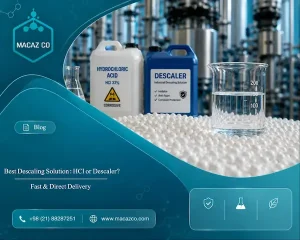
Hydrochloric Acid (HCl) for Descaling: High Performance at a Low Cost
Hydrochloric Acid (HCl), commonly known as industrial muriatic acid, is one of the strongest mineral acids and is widely used for pickling steel and cleaning heavy industrial equipment.
Advantages of Hydrochloric Acid
- Fast Scale Removal: Quickly dissolves hard and aged calcium carbonate deposits.
- Cost-Effective: More economical than many alternative descaling chemicals, especially for large-scale operations.
- Widely Available: Easily obtainable in industrial grades with concentrations of 30–33%.
Disadvantages of Hydrochloric Acid
- Highly Corrosive: Without a corrosion inhibitor, it can seriously damage sensitive metals such as copper, brass, and stainless steel.
- Produces Acidic Fumes: The reaction with scale releases corrosive gases, making proper ventilation essential.
What Is a Descaler and How Is It Different?
A descaler is a ready-to-use descaling formulation. Most commercial descalers are based on modified hydrochloric acid combined with additives such as corrosion inhibitors and anti-foaming agents.
Advantages of Descaler
- Low Metal Corrosion: Built-in corrosion inhibitors allow the acid to dissolve scale while protecting the base metal, including copper, brass, and cast iron.
- Safer Operation: Easier to control than raw acid, significantly reducing the risk of equipment damage.
- Prevents Pitting Corrosion: Helps protect thin copper tubes in chillers and fan coil units from perforation.
Disadvantages of Descaler
- Higher Initial Cost: Specialized additives increase the overall product price compared to raw hydrochloric acid.
Hydrochloric Acid vs. Descaler: Comparison Table
Comparison | Hydrochloric Acid (Pure HCl) | Industrial Descaler |
Scale Dissolving Speed | Very fast | Fast and controlled |
Metal Corrosion | High (requires inhibitor) | Very low (contains inhibitor) |
Safe for Copper & Brass | Not recommended without precise inhibitor dosage | Yes |
Initial Cost | Lower | Higher |
| Equipment Safety | Requires experienced operators | Lower operational risk |
Which Product Is Best for Your Equipment?
The ideal descaling solution depends on the type of equipment and the materials involved.
Chillers, Copper Heat Exchangers, and Fan Coil Units
Industrial descaler is the preferred choice because copper tubes are highly vulnerable to corrosion, and untreated hydrochloric acid may cause severe damage.
Steel and Cast Iron Boilers
Industrial hydrochloric acid, used with the appropriate dosage of an acid corrosion inhibitor, offers an economical and highly effective solution.
Large Pipelines and Storage Tanks
For high-volume descaling projects, hydrochloric acid combined with a separate corrosion inhibitor significantly reduces operating costs.
Five Essential Safety Tips for Acid Cleaning
- Always Use a Corrosion Inhibitor when working with pure hydrochloric acid.
- Wear Appropriate PPE, including acid-resistant gloves, safety goggles, protective clothing, and a suitable respirator.
- Control Circulation Time. Acid cleaning typically lasts between 2 and 6 hours, depending on the scale thickness.
- Neutralize the System after cleaning using a mild alkaline solution (such as sodium hydroxide or sodium carbonate) until the pH reaches neutral.
- Perform a Final Water Flush until the discharge water is completely clear.
Final Verdict: Hydrochloric Acid or Descaler?
The right choice depends on your equipment and operating conditions.
If your system contains copper or brass components, an industrial descaler is the safest option because it minimizes corrosion while effectively removing scale.
For large steel boilers, heavy-duty equipment, and extensive pipeline systems, high-quality hydrochloric acid used with a corrosion inhibitor provides the most economical and powerful descaling solution.
For current pricing, technical consultation, proper acid dosage recommendations, and the supply of industrial hydrochloric acid, descalers, and sodium hypochlorite, contact the experts at Maad Chlor.
High-Quality Industrial Chemicals from Maad Chlor
Maad Chlor is a trusted supplier of industrial chemicals in Iran, providing certified products with guaranteed quality and verified analytical reports.
We supply a wide range of industrial chemicals, including:
- Industrial Paraffin for textile manufacturing, candle production, and lubrication
- Sodium Hypochlorite (Bleach) for water treatment and disinfection
- Hydrochloric Acid (HCl) for metal cleaning and industrial applications
Our experienced team is ready to provide expert consultation and fast nationwide delivery.
Direct Sales Contact: +98 (21) 88287251
Sales & Online Orders: +98 912 019 9853
Maad Chlor – Your Trusted Partner for High-Quality Industrial Chemicals.