
5 Dangerous Storage Mistakes: Hydrochloric Acid & Sodium Hypochlorite
Introduction
Safety in the chemical industry is the top priority for any facility. Hydrochloric Acid (industrial salt essence) and Sodium Hypochlorite (Bleach) are two widely used industrial substances that, while highly beneficial, can be disastrous if not stored correctly. Many industrial accidents occur during storage rather than usage. At Maad Chlor Azar Abadegan, alongside producing top-quality chemicals, we are committed to enhancing our clients’ safety knowledge.
In this article, we review 5 dangerous and common mistakes in storing Hydrochloric Acid and Sodium Hypochlorite to help you protect your personnel and equipment.
Storing Hydrochloric Acid and Sodium Hypochlorite Together (The Biggest Mistake)
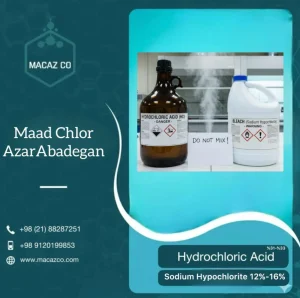
Perhaps the most common and dangerous error is placing tanks of these two substances adjacent to each other. Why is this dangerous? If Hydrochloric Acid mixes with Sodium Hypochlorite for any reason (tank leakage, spills on the floor, or human error during handling), a severe chemical reaction occurs, releasing Chlorine Gas. This yellow-green gas is highly toxic and asphyxiating, capable of causing severe lung damage or even death to warehouse personnel within minutes.
- The Correct Solution: Store tanks of these two substances at a safe distance (at least 3 to 5 meters) from each other. If possible, use containment walls (Berms) so that in the event of a leak, the liquids do not mix.
Using Inappropriate Tank Materials
Every chemical has its specific “corrosivity.” Choosing the wrong tank material can lead to punctures and the leakage of thousands of liters of acid.
- For Hydrochloric Acid: This acid is highly corrosive to metals. Never use metal tanks (standard steel, iron, etc.) without an internal lining. The best options are Polyethylene (PE) tanks, Reinforced Fiberglass (FRP), or Rubber Lined metal tanks.
- For Sodium Hypochlorite: It is also corrosive and sensitive to sunlight. Some plastics become brittle upon contact with Sodium Hypochlorite. High-Density Polyethylene (HDPE) tanks are suitable options.
Ignoring Temperature and Sunlight (The Killer of Sodium Hypochlorite Quality)
This issue causes more financial loss than safety risks, destroying your product quality. Sodium Hypochlorite is an unstable substance. If stored in direct sunlight or very hot environments, chlorine gas degasses from the solution, and the concentration (active ingredient) drops drastically.
Hydrochloric Acid also generates very pungent acidic fumes at high temperatures, causing corrosion to warehouse electronics and metal roof structures.
- The Correct Solution: The warehouse must be roofed, cool, and away from direct sunlight. For outdoor Sodium Hypochlorite tanks, ensure you use light colors (white) and proper insulation.
Inadequate Warehouse Ventilation
Even if drums and tanks are sealed, some chemical fumes are always present in the warehouse atmosphere.
- Hydrochloric Acid fumes are heavier than air and settle on the warehouse floor.
- Sodium Hypochlorite fumes are respiratory irritants.
A poor ventilation system leads to the accumulation of these fumes, eventually rotting electrical wiring and forklifts, and damaging workers’ lungs. Your warehouse must be equipped with both natural and mechanical ventilation (using spark-proof and acid-resistant fans).
Lack of Labeling and Personnel Awareness
Many accidents occur when a new operator mistakes an acid jerrycan for Sodium Hypochlorite and empties it into the wrong tank.
- Essential Actions:
- All tanks, pipes, and valves must have clear, large labels.
- Using color codes (e.g., Yellow for acid, Blue for alkali) is very helpful.
- Material Safety Data Sheets (MSDS) for each substance must be posted at the warehouse entrance.
Conclusion: Prevention is Cheaper than Accidents
Observing these 5 simple rules for storing Hydrochloric Acid and Sodium Hypochlorite not only saves lives but also prevents heavy financial damage to factory facilities. At Maad Chlor Azar Abadegan, we supply our products (Chlorinated Paraffin, Hydrochloric Acid, and Sodium Hypochlorite) in standard, safe packaging to minimize your storage risks.
Frequently Asked Questions (FAQ)
- Can Hydrochloric Acid and Sodium Hypochlorite drums be stored on the same pallet? No, it is strictly prohibited. A potential leak from one of the drums could cause an explosive reaction.
- What is the best temperature for storing Sodium Hypochlorite? The ideal temperature is between 15 to 25 degrees Celsius. Higher temperatures accelerate the decomposition of the substance.
🏭 Buy Industrial Sodium Hypochlorite with Guaranteed Quality from Maad Chlor
Maad Chlor Company is a direct supplier of high-purity industrial Sodium Hypochlorite. Our products are supplied observing safety standards, in resistant packaging, and with valid analysis.
If you are looking to purchase Sodium Hypochlorite for water treatment, disinfection, or manufacturing industries:
🌿 Contact Maad Chlor experts now so we can recommend the most suitable option for your application.
📞 Direct Sales Contact: +98 (21) 88287251 💬 Price Inquiry & Online Order: +98 9120199853