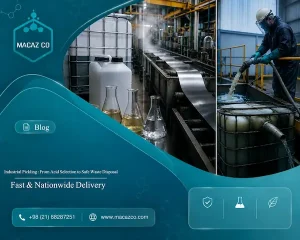
Comprehensive Guide to Industrial Acid Pickling: From Acid Selection to Safe Waste Disposal
In modern industries, removing scale and cleaning metal surfaces, boilers, heat exchangers, and pipelines is one of the most critical aspects of equipment maintenance and production efficiency. Industrial Acid Pickling is recognized as the most effective method for eliminating rust, oxide layers, and stubborn mineral deposits. However, the success of this process depends on three essential factors: selecting the appropriate acid, following strict safety procedures, and ensuring environmentally compliant waste disposal.
In this comprehensive guide, we examine the entire industrial acid pickling process—from acid selection to waste management—providing an engineering-based approach that maximizes equipment performance while maintaining workplace safety.
What Is Industrial Acid Pickling and Why Is It Important?
Industrial acid pickling is a chemical cleaning process in which metal surfaces—particularly steel—are treated with acidic solutions to remove oxide layers, mill scale, rust, and mineral deposits formed during manufacturing or prolonged operation.
Failure to perform regular acid pickling can result in significant operational and financial losses, including:
- Reduced Heat Transfer Efficiency: As little as 1 mm of scale can decrease heat transfer efficiency by up to 15%.
- Under-Deposit Corrosion: Deposits create ideal conditions for hidden corrosion, eventually causing leaks or pipe failures.
- Higher Energy Consumption: Scaling forces equipment to consume more energy while accelerating mechanical wear.
Step 1: Choosing the Right Acid
Selecting the proper acid is the most critical stage of industrial acid pickling. Different acids react differently with various metals and contaminants.
Hydrochloric Acid (HCl): The Preferred Choice for Steel Pickling
Hydrochloric Acid (HCl) is the most widely used acid in steel manufacturing and industrial descaling.
Advantages
- Rapid dissolution of iron oxides and rust
- Excellent cleaning performance at room temperature
- No heating required, reducing operational costs
- Produces a smooth, clean, and bright metal surface
Applications
- Steel sheet pickling lines
- Boiler cleaning
- Removal of rust and mineral scale from industrial equipment
Sulfuric Acid (H₂SO₄)
Sulfuric acid is generally effective only at elevated temperatures (typically above 60°C). Although its purchase cost may be lower than hydrochloric acid, the additional energy required for heating and the increased safety risks often make it a less economical choice.
Mild Acids (Phosphoric, Citric, and Sulfamic Acids)
These acids are commonly used for sensitive metals such as copper and brass or in applications involving light deposits where aggressive cleaning is unnecessary.
Step 2: The Critical Role of Corrosion Inhibitors
While acids dissolve oxide layers and mineral deposits, they can also attack the underlying metal if the process is not properly controlled.
To prevent unnecessary metal loss, corrosion inhibitors are added to the acid solution. These chemicals form a protective molecular film on the exposed metal surface, significantly reducing corrosion while allowing the acid to continue dissolving rust and scale efficiently.
Using a suitable inhibitor is essential for maintaining equipment integrity and extending service life.
Step 3: Safety Requirements According to MSDS Guidelines
Industrial acids are highly corrosive chemicals that require careful handling. According to the Material Safety Data Sheet (MSDS), the following safety precautions are mandatory during acid pickling operations:
Personal Protective Equipment (PPE)
Operators should wear:
- Acid-resistant gloves
- Chemical-resistant protective clothing
- Safety boots
- Respiratory protection suitable for acid fumes
- Chemical splash goggles or face shields
Proper Ventilation
Acid pickling generates hazardous vapors that must be removed using an effective ventilation system or industrial scrubber.
Emergency Equipment
Emergency showers and eyewash stations should be readily accessible in all acid pickling areas.
Step 4: Neutralization and Safe Disposal of Acidic Waste
Spent acid solutions contain low pH levels and dissolved heavy metals, making direct discharge into sewage systems or the environment both hazardous and illegal.
Standard Acid Waste Management Procedure
Collection
Spent acid should be collected in dedicated acid-resistant or polyethylene storage tanks.
Neutralization
Alkaline materials such as lime (calcium hydroxide) or caustic soda (sodium hydroxide) are added gradually until the solution reaches a neutral pH of approximately 6.5–8.5.
Heavy Metal Precipitation
During neutralization, dissolved heavy metals precipitate and form sludge.
Filtration and Disposal
After laboratory testing confirms compliance with environmental regulations, the treated water may be discharged into approved industrial wastewater systems. The remaining sludge must be transported to licensed hazardous waste disposal facilities.
High-Quality Industrial Acids: The Foundation of an Efficient Pickling Process
An effective acid pickling operation depends on high-purity industrial chemicals with minimal impurities. Contaminated acids can reduce cleaning efficiency, damage equipment, and compromise production quality.
Maad Chlor AzarAbadegan, with more than 16 years of successful experience in the chemical industry since 2007, has established itself as one of Iran’s trusted manufacturers and suppliers of industrial chemicals.
Since 2023, the company has adopted a knowledge-based manufacturing strategy, investing in advanced technologies and modern production methods to improve product quality and support industrial self-sufficiency.
By combining technical expertise, experienced professionals, and a strong commitment to quality, Maad Chlor AzarAbadegan manufactures and supplies premium industrial acids and specialty chemicals that meet the demanding requirements of industrial acid pickling applications.
For expert consultation on selecting the most suitable acid for your production process or to request current pricing information, our technical team is ready to assist you.
Purchase Premium Industrial Chemicals from Maad Chlor AzarAbadegan
Maad Chlor AzarAbadegan is a trusted supplier of industrial chemicals in Iran, providing certified products with guaranteed quality and verified laboratory analysis.
We supply a wide range of industrial chemicals, including:
- Industrial Paraffin for textile manufacturing, candle production, and lubrication applications.
- Sodium Hypochlorite (Bleach) for water treatment, sanitation, and industrial disinfection.
- Hydrochloric Acid (HCl) for metal cleaning, industrial pickling, and chemical processing.
Our experienced sales and technical team is ready to provide professional consultation and fast nationwide delivery.
Direct Sales Consultation: +98 (21) 88287251
Online Price Inquiry & Orders: +98 912 019 9853
Maad Chlor AzarAbadegan — Your Trusted Partner for High-Quality Industrial Chemicals.